
Insights



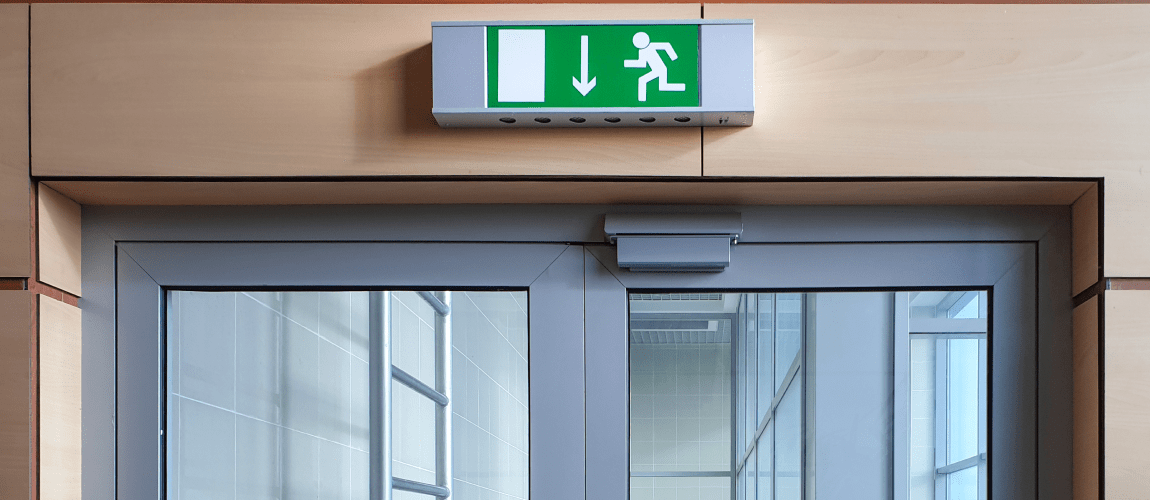
In many buildings, access control and fire safety are treated as two separate conversations. One sits with security, safeguarding, or operational control. The other sits with compliance, evacuation, and life safety. In practice, those two systems have to work together.
That is especially true where electronically controlled doors sit on escape routes, protect sensitive areas, or manage movement around a school, office, healthcare site, or multi-building estate. If a door is secure in normal use but does not behave correctly in an emergency, the problem is not just inconvenient. It can affect evacuation, emergency access, and overall compliance.
This is where integration matters. Salto access control systems can be integrated with fire alarm systems so that doors respond appropriately when an alarm activates. Done properly, this helps buildings maintain strong day-to-day security while still supporting safe, predictable egress in a fire situation.
Controlled doors are increasingly common in commercial and educational buildings. They help manage who can enter, when they can enter, and which areas should remain restricted. In schools, that can support safeguarding and visitor management. In offices and mixed commercial sites, it can protect staff areas, plant spaces, data rooms, shared entrances, and tenant zones.
However, a secure door is only part of the picture. A door on an escape route may also need to release, change state, or allow free egress when the fire alarm operates. UK fire safety guidance makes clear that responsible persons must ensure appropriate fire detection, warning, and escape arrangements are in place. Where doors, hold-open devices, or release mechanisms interact with fire safety systems, those interfaces must operate reliably.
For facility managers, the key point is simple. Security measures must never undermine escape. That is why access control and fire alarm design should be considered together from the start, rather than bolted together at the end of a project.
In practical terms, integration allows the access control system and the fire alarm system to share signals so that selected doors behave in a pre-defined way during an alarm event.
That does not mean every door unlocks in the same way. Instead, the system should be designed around the building’s fire strategy, escape routes, occupancy, and security needs. Some doors may fail safe and release on alarm. Others may remain secure from the outside while always permitting escape from the inside. Some doors may change mode only in defined circumstances.
Salto’s platform supports integration with wider building and security systems, including fire alarms, while its software environment allows alarm events and triggers to be configured for connected hardware. In simple terms, that means a fire signal can prompt a controlled response at the door, rather than leaving staff to manage everything manually.
The most common response is that designated doors release or move into a safe state so occupants can leave without delay. That might involve unlocking a maglock, releasing an electric strike, changing the status of an electronically controlled door, or ensuring free exit is available along the escape route.
In some buildings, the response may also involve related devices. Fire doors held open for convenience may close on alarm. Doors linked to access control may release to support evacuation or fire service access. The correct behaviour depends on the fire strategy and on the hardware installed at each opening.
The important point is that integration is not a cosmetic feature. It forms part of the building’s emergency operation.
Not every controlled door should be treated identically. The doors that matter most are those that affect means of escape, final exits, circulation on evacuation routes, and any location where delay could place occupants at risk.
For example, a school may have access-controlled entrance points, staff-only areas, safeguarding zones, and internal compartment lines. A commercial site may have reception lobbies, lift lobbies, comms rooms, tenant entrances, and plant areas. The requirement at each opening may differ depending on whether the door sits on an escape route, whether it is a fire-resisting door, whether re-entry is needed, and how occupants are expected to move during an emergency.
That is why a blanket approach is risky. A door-by-door review is usually needed so the integration supports evacuation without accidentally weakening the site’s wider security arrangements.
One of the main benefits of an integrated electronic system is flexibility. During normal operation, Salto can support controlled access, time-based permissions, audit trails, and restricted movement across sensitive areas. During an alarm condition, selected doors can behave differently according to the agreed strategy.
That balance is particularly useful in schools and colleges. Department for Education guidance supports the use of access control at main entrances and other vulnerable points, while also making clear that doors must still be capable of being unlocked from the inside in an emergency. The same principle applies in commercial premises. Security has to be robust, but escape must remain clear and dependable.
Integration also supports clearer management. Instead of relying purely on physical keys, ad hoc local overrides, or inconsistent hardware decisions over time, facility managers can work from a planned and documented system logic. That makes the building easier to manage, especially where there are multiple controlled doors across a larger estate.
Good integration starts with the opening, not the software screen. The lock type, door hardware, power arrangement, closer performance, route function, and door set construction all influence how a controlled door should behave in an emergency.
Fail-safe and fail-secure principles are often discussed here, but they need to be applied carefully. A simple label is not enough on its own. The real question is how people will exit, how the door will release, what happens on alarm or power loss, and whether the arrangement remains aligned with the building’s fire strategy.
This is also why integration should not be copied blindly from one project to another. A commercial office with layered access control may need a different approach from a school, a healthcare environment, or a site with public-facing areas. The fire alarm cause-and-effect, the evacuation strategy, and the security objectives all need to be considered together.
Even a well-designed system still needs to be proven in operation. Commissioning should confirm that the doors respond correctly when the fire alarm activates, that release functions work as intended, and that any interfaces between systems are reliable.
Routine testing matters for the same reason. A building can appear compliant on paper but still develop real-world problems through hardware wear, software changes, isolated local adjustments, or poor maintenance coordination. A door that should release may not. A door that should close may not latch correctly. A local change to access permissions may unintentionally affect emergency behaviour.
For facility managers, this is one of the strongest arguments for joined-up maintenance. If access control and fire alarm servicing are handled in isolation, issues at the interface can be missed. Where integration is important, the systems should be tested as an integrated arrangement, not as separate technical silos.
A common mistake is assuming that all electronically secured doors should simply unlock on alarm. In some cases that is correct, but in others it can create operational problems, reduce compartmentation benefits, or conflict with the intended strategy for the building. The right answer depends on the door’s role.
Another mistake is allowing security upgrades to outpace fire strategy reviews. Over time, sites often add readers, locks, intercoms, and restricted areas in response to operational pressures. If those changes are not reviewed against evacuation and life safety requirements, the result can be a patchwork of doors that behave inconsistently in an emergency.
Training is another overlooked issue. Staff need to understand how key doors will respond, what local emergency release arrangements exist, and how to report faults quickly. Technology supports safety, but people still need to know what good looks like.
The right starting point is a site survey and design review that considers both security and fire safety together. That should look at escape routes, door functions, hardware, access control objectives, fire alarm interfaces, and ongoing maintenance responsibilities.
For some buildings, the solution may be straightforward. For others, particularly those with multiple entrances, safeguarding concerns, tenant divisions, or phased refurbishments, a more detailed integration strategy may be needed.
What matters most is that access control and fire alarm systems are not specified in isolation. When the two are designed, installed, tested, and maintained as part of one coordinated plan, buildings are easier to secure, easier to manage, and better prepared for emergency conditions.
For organisations managing commercial properties, education settings, or wider estates, that joined-up approach can make the difference between a system that merely controls doors and one that actively supports both safety and compliance.
Follow Us |

|

|

|
© ECS Systems 2026
ECS Systems Limited, 75 Station Rd, Sidcup DA15 7DN
|
|
|
|
© ECS Systems 2026