
Insights



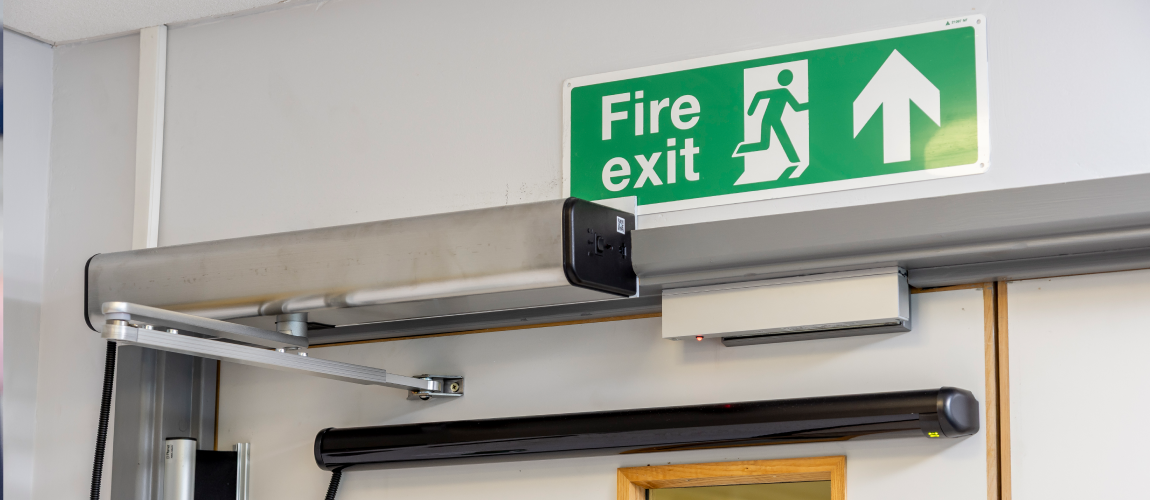
In schools, fire doors are part of the building’s active fire protection strategy. They help hold back fire, smoke, and toxic gases, protect escape routes, and support safe evacuation. When a fire door fails, the problem is not cosmetic. It can undermine compartmentation, shorten available escape time, and increase the risk to pupils, staff, contractors, and visitors.
That is why defects on school fire doors deserve close attention. Educational buildings place unusual pressure on doorsets. High footfall, movement between lessons, deliveries, cleaning routines, safeguarding arrangements, and the general wear of busy estates all increase the chance that a door which was compliant at installation gradually drifts out of condition. Government guidance for schools says fire doors should remain in efficient working order, be regularly checked and maintained by a competent person, and that inspections should include self-closing devices, hold-open release, glazing, signage, free operation, and signs of warping or damage. The Department for Education has also highlighted common issues found during school fire risk assessments, including inoperable exits, non-compliant internal fire doors, blocked or locked final exits, door mechanisms not closing effectively, and locks that affect fire resistance.
For facility managers, estates teams, bursars, and responsible persons, the challenge is practical. What defects show up most often in schools, why do they matter, and how should they be fixed properly? The answer is usually not a quick patch. It is a combination of routine checks, competent inspection, and remedial work that respects the tested performance of the complete doorset.
A fire door only does its job when the full assembly performs as intended. The door leaf, frame, seals, glazing, hinges, latch, closer, and any hold-open arrangement all work together. If one part is missing, damaged, unsuitable, or badly adjusted, the whole set can be compromised.
In a school, that matters because escape routes and protected stairways need to remain usable while the building is evacuated. Department for Education guidance notes that stair enclosures are a key area to protect and that long corridors also need self-closing fire doors where required by the fire strategy. If the door on a protected route does not close, does not latch, or no longer seals properly, smoke can spread much faster than expected.
This is why many school fire door problems begin as maintenance issues but become compliance issues very quickly. A worn closer, a damaged vision panel, a new lock fitted for convenience, or a wedge used every day can all turn a compliant door into a weak point.
One of the most common problems in schools is a fire door that no longer closes fully into the frame and latches. The closer may be worn, disconnected, badly adjusted, or fighting against another issue such as warped alignment or damaged hinges.
This matters because a fire door is tested in the closed position. If it sticks open slightly, drifts slowly, or fails to latch from a modest opening angle, it cannot be relied upon in a real fire.
How to fix it:
Inspect the closer, hinges, latch, and frame alignment together rather than assuming the closer alone is the issue. Adjustments may resolve a minor problem, but worn or unsuitable components should be replaced with compatible fire-rated hardware by a competent specialist. Once repaired, the door should be tested to confirm it closes fully and consistently.
Schools often struggle with this defect because staff need doors to be convenient during busy periods, deliveries, circulation changes, or supervision of corridors. In practice, this can lead to wedges, bins, furniture, or improvised methods being used to hold doors open.
A propped-open fire door offers no fire compartmentation at all. Government school guidance is explicit that fire doors will not fulfil their purpose if they are propped open, and that hold-open devices must work effectively.
How to fix it:
Remove informal wedges and obstructions immediately. Where a door genuinely needs to stay open for operational reasons, use an appropriate automatic release arrangement linked to the fire alarm system, or review whether the current door arrangement is right for the space. Staff awareness is also essential, because the same misuse often returns if the operational problem is not addressed.
Seals are frequently overlooked because they can appear minor, but they are essential. Intumescent seals expand under heat to close gaps, while smoke seals help restrict smoke spread at earlier stages.
In school environments, seals can loosen, tear, be painted over, be cut during ad hoc repairs, or disappear altogether after repeated maintenance works.
How to fix it:
Any damaged, missing, or painted-over seals should be replaced with the correct type for that specific doorset. Generic substitutions are risky, because seals must be compatible with the tested performance of the door, frame, and hardware. This is not a detail to leave vague on a maintenance list.
Gaps around the head and vertical edges are a frequent inspection issue. Over time, wear, poor installation, building movement, repeated impact, or changes to flooring can leave the door with gaps that are uneven or visibly too large.
The danger is simple. Excessive gaps allow smoke and fire to bypass the line of defence the door is meant to create. Fire door specialists regularly identify gap problems as one of the most common reasons doors fail inspection.
How to fix it:
Measure the gaps properly rather than relying on a visual guess. Minor issues may be corrected through adjustment, refitting, or approved edge solutions, but significant gap failures can point to wider installation defects or incompatible previous repairs. In some cases, replacement of part or all of the doorset is the safest route.
School doors take knocks. Trolleys, chairs, equipment, bags, and heavy daily use can all cause dents, splits, edge damage, or distortion. Problems also arise when doors are trimmed excessively, cut for new hardware, or altered to accommodate later works.
Government guidance for schools specifically says inspections should check that doors open and close freely, are free from damage, and show no distortion or warping.
How to fix it:
Assess whether the damage is superficial or whether it affects the fire performance of the door. Small surface wear is not the same as structural damage, but altered leaves, split edges, or distorted frames should be treated seriously. Fire door remediation should restore the tested specification; where that is not possible, replacement is usually more defensible than repeated patch repairs.
Vision panels are common in schools because visibility between spaces is often important for supervision and safeguarding. However, they are also a regular point of failure. Glazing can crack, beading can loosen, seals can fail, or standard glass can be substituted during later works.
The Department for Education’s school estate guidance specifically says inspections should check that glazed panels are intact and undamaged. If the glazed element is compromised, the performance of the whole doorset can be affected.
How to fix it:
Any damaged panel, defective beading, or uncertain glazing specification should be reviewed by a competent fire door specialist. Replacements must match the tested and certified configuration for that door. This is not a standard joinery repair.
Another common issue in schools is the addition of locks, access devices, kick plates, or other hardware without considering fire performance. Department for Education guidance flags locks fitted in a way that affects fire resistance as a common issue during school risk assessments.
This often happens for understandable reasons. A room needs better security, access is being controlled more tightly, or a maintenance team swaps hardware like-for-like without realising that the original item was part of a tested fire doorset.
How to fix it:
Review any added or replacement ironmongery against the doorset specification. Remove non-compliant items and replace them with suitable, fire-rated components fitted correctly. Where security or safeguarding needs have changed, the fire door should be reassessed as part of the wider door strategy rather than modified informally.
Signage can seem minor, but it supports correct use. School estate guidance says inspections should confirm the correct warning signs are in place, such as “fire door keep closed” or “automatic fire door keep clear” where relevant.
Missing signage often sits alongside wider management problems. If users do not understand whether a door should be kept shut, held clear, or linked to automatic release, misuse becomes more likely.
How to fix it:
Fit the correct signage for the type and operation of the door, and check that it remains visible and appropriate after repainting or refurbishment. Signage should support the way the door is meant to function, not contradict it.
In schools, movement of furniture, PE equipment, deliveries, bins, and temporary storage can quickly obstruct a fire door or final exit. The Department for Education has identified locked, blocked, or bolted final exits and fire doors as a recurring issue.
This is especially serious where the affected doors protect circulation routes, stair cores, or exits used during evacuation.
How to fix it:
Build checks into daily and weekly site routines so obstructions are picked up quickly. Where a recurring obstruction problem exists, deal with the operational cause, not only the symptom. That may mean changing storage arrangements, traffic routes, or staff responsibilities.
A final defect is administrative rather than physical, but it is common. Schools may identify problems during a walkround or fire risk assessment, yet fail to log them properly, assign ownership, track remedials, or verify completion. The same defective door then appears again and again.
How to fix it:
Keep a clear fire door register or compliance log showing location, defect, priority, action required, responsible party, target date, and completion status. For larger schools, campuses, or multi-academy trusts, this becomes essential for estate-wide oversight.
The answer is usually a mix of operational pressure and fragmented maintenance. School buildings are rarely static. Classrooms change use, safeguarding arrangements evolve, hardware is replaced for convenience, and doors are exposed to constant traffic.
The other recurring problem is piecemeal repair. A closer may be adjusted without addressing frame distortion. A seal may be replaced without checking gap tolerances. A lock may be changed without checking whether it remains suitable for the tested door. Each local fix can create a new compliance problem somewhere else.
The most effective approach is to treat fire doors as complete systems rather than individual joinery items. Start by identifying which defects are obvious maintenance issues and which indicate a deeper problem with specification, condition, or compatibility.
Some faults can be resolved through competent adjustment or component replacement. Others point to the need for more extensive remedial work, or even replacement of the complete doorset. The right answer depends on whether the original fire performance can still be demonstrated and restored.
This is why schools should be cautious about informal repairs. Fire door components are not interchangeable by default. Repairs should use compatible, fire-tested products and be carried out by people who understand how the full assembly is meant to perform.
A sensible strategy combines three layers. First, staff and site teams should remain alert to obvious misuse, damage, and obstruction during daily operation. Secondly, schools should carry out planned inspections and keep records of defects and completed works. Thirdly, competent specialists should undertake more detailed surveys where defects are repeated, widespread, or technically uncertain.
For single schools, that supports clearer compliance management. For trusts and larger estates, it also allows patterns to be tracked across blocks and sites, helping teams prioritise higher-risk doors, budget for remedials, and avoid repeated failures.
The most common fire door defects found in schools are rarely mysterious. Doors fail to self-close, get wedged open, lose their seals, develop excessive gaps, suffer damage, receive unsuitable hardware, or become part of a maintenance backlog. The real problem is that these issues are easy to normalise in busy educational buildings.
For facility managers and responsible persons, the best response is to treat fire doors as safety-critical assets. That means checking them regularly, recording defects properly, fixing them with compatible products and competent workmanship, and taking a wider view across the whole estate. Done well, that not only supports compliance. It protects escape routes, preserves compartmentation, and makes the school environment safer for everyone who uses it.
Follow Us |

|

|

|
© ECS Systems 2026
ECS Systems Limited, 75 Station Rd, Sidcup DA15 7DN
|
|
|
|
© ECS Systems 2026