
Insights



In commercial buildings, fire doors are easy to overlook until an inspection reveals that they are not performing as intended. That is a problem, because a fire door is not just another door. It is part of the building’s fire compartmentation strategy, designed to resist the spread of fire and smoke long enough to protect escape routes, support evacuation, and reduce damage across the wider site.
For commercial building managers, responsible persons, and estates teams, this means fire door compliance is not only about having fire doors in place. It is about ensuring each door assembly continues to work properly in real conditions, despite daily traffic, maintenance activity, and the gradual wear that comes with busy environments.
That is why commercial inspections so often focus on the same patterns of failure. In many buildings, the issue is not one dramatic defect. It is a collection of smaller faults that, taken together, compromise the integrity of the door set. A closer that no longer latches properly, a damaged seal, an excessive gap at the head, or an unauthorised alteration after other works can all weaken the door’s performance when it matters most.
A compliant fire door helps maintain compartmentation, limits the movement of smoke and heat, and protects the escape strategy built into the premises. In offices, warehouses, healthcare settings, education sites, mixed-use buildings, and larger commercial estates, that function is critical. If a fire door fails, fire and smoke can spread more quickly into corridors, stairs, plant spaces, and adjoining compartments, increasing the risk to occupants and disrupting evacuation.
The challenge for commercial premises is that fire doors are used constantly. They are opened, wedged, knocked, repainted, adjusted, and sometimes altered by third parties during unrelated works. Over time, even well-specified fire doors can drift out of tolerance if inspections and maintenance are not planned properly.
That is why routine surveys matter. They identify the doors that appear sound at first glance but are failing in ways that only a trained inspection will pick up.
A fire door is intended to hold back fire and smoke for a defined period when correctly specified, installed, and maintained. In practice, that helps keep escape routes usable for longer, protects adjoining spaces, and supports the wider passive fire protection strategy within the building.
Because fire door performance depends on the whole assembly, relatively small defects can have a serious effect. A missing seal, a poor latch, or a frame that has shifted over time may seem minor in isolation, but the door can only do its job if its key components work together.
Below are ten of the issues most frequently identified during commercial fire door inspections.
Gap tolerances are one of the first things an inspector will check. If the clearance between the door leaf and frame is too large, the door may not provide the intended resistance to fire and smoke. Excessive gaps are commonly found at the head and sides, but they can also appear at the meeting edges of double doors.
In older buildings, settlement, repeated use, or poor adjustment can all contribute. In refurbished sites, the problem may stem from poor installation or later modifications. Excessive gaps are often easy to miss visually, but they are one of the clearest warning signs that a door set needs closer attention.
Intumescent seals and smoke seals are critical parts of many fire door assemblies. If they are missing, painted over, damaged, poorly fitted, or replaced with the wrong type, the door’s performance may be compromised.
This is one of the most common failures in commercial inspections because seals are vulnerable to wear, impact, cleaning, and unapproved maintenance. Once damaged, they are sometimes ignored because the door still appears to open and close normally. From a fire safety perspective, however, appearance alone is not enough.
A fire door that does not close and latch correctly is a significant defect. The cause may be a worn or incorrectly adjusted self-closing device, misalignment, damaged hinges, air pressure issues, floor coverings, or other obstructions.
In busy commercial premises, doors are often expected to cope with frequent use and hard treatment. That makes closer performance especially important. If a door stalls before it reaches the frame, rebounds, or fails to latch reliably, the issue should not be dismissed as a minor inconvenience. It is a direct performance concern.
Hinges, latches, closers, locks, hold-open devices, and other items of ironmongery all influence how a fire door performs. Commercial inspections often uncover missing screws, unsuitable replacement hardware, poorly adjusted closers, loose hinges, or hardware that has been swapped without regard to the original fire door specification.
This tends to happen over time, particularly where buildings rely on reactive maintenance rather than controlled fire door remediation. A single piece of incorrect hardware can affect closing action, smoke resistance, or the structural integrity of the assembly.
Impact damage, delamination, drilled holes, splits, edge damage, and general deterioration are all common findings. In some cases, building users may assume that cosmetic damage does not matter. In reality, any damage that affects the construction of the door or frame may affect fire performance.
Commercial environments with trolleys, deliveries, equipment movement, and high footfall are especially prone to this issue. Damage around hinges, latches, and closer fixings is also common because these points are under repeated stress.
Fire-resisting glazed elements need to match the tested construction of the door assembly. During inspections, it is not unusual to find vision panels that have been replaced incorrectly, damaged beads, cracked glazing, loose fixings, or later modifications that have not been assessed properly.
This is a particular risk in buildings where changes are made quickly to improve visibility, accessibility, or day-to-day operation without full consideration of the door’s certified design. A glazed opening is not automatically a problem, but it must be appropriate to the door set.
Many commercial fire door failures begin after unrelated works. Contractors may cut in new hardware, drill additional openings, overpaint seals, add kick plates, alter signage, or trim the door leaf to suit flooring changes or operational needs.
Individually, these changes may seem practical. Collectively, they are one of the most common reasons fire doors drift away from their original tested specification. Inspections frequently identify doors that have been altered several times over the years, with no clear record of whether the work was suitable.
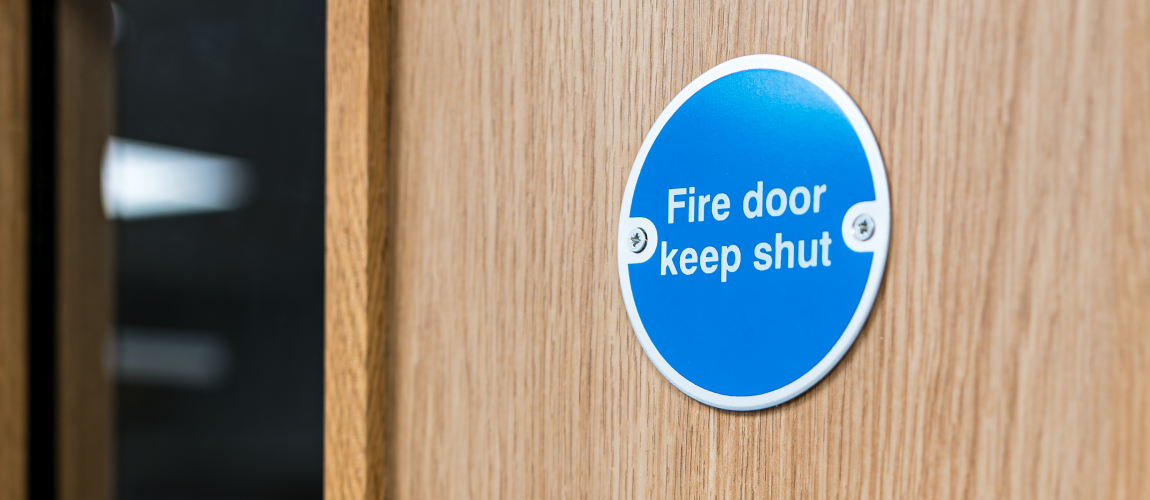
Fire door signage is sometimes treated as a minor issue, but it matters for both compliance and day-to-day use. Missing signs, damaged signs, incorrect wording, or badly positioned signs can all lead to misuse, especially in shared or high-traffic areas.
Where doors need to remain shut, or where hold-open arrangements apply only under certain conditions, clear and durable signage helps reinforce correct use. Poor signage rarely appears on its own. It often sits alongside wider maintenance and management weaknesses.
The gap beneath the door and the relationship between the door leaf, floor finish, and threshold can be another recurring problem. New carpets, altered floor levels, worn thresholds, or poorly planned refurbishments can change the clearance enough to affect performance.
Commercial inspections often uncover doors that now catch on new floor finishes, fail to close under their own power, or have excessive clearance beneath the leaf. These issues are particularly common after fit-out works where the door itself has not been reviewed as part of the wider project.
Not every failure is physical. In many commercial buildings, one of the most serious findings is the absence of a clear inspection history, maintenance record, or ownership structure for remedial actions.
Where responsibility is split across landlords, managing agents, tenants, contractors, or estates teams, defects can remain unresolved because no one has a complete view of the door stock or the remediation priority. In multi-site portfolios, that issue becomes even more pronounced. A door may have been noted previously, but if the record is incomplete or the follow-up unclear, the risk remains.
The main reason is that fire doors are exposed to everyday pressure. In commercial environments, they are part of daily circulation and operational use. They are opened hundreds of times, held back for convenience, knocked by equipment, and affected by temperature, settlement, and general wear.
Another reason is that fire doors are often only reviewed when a survey, risk assessment, or compliance concern brings them into focus. By that point, the building may already have a pattern of repeated defects across multiple doors, especially if remedial works have been reactive rather than planned.
High traffic makes small faults more likely and more visible over time. A slight misalignment can become a closing failure. A loose hinge can distort the leaf position. Repainting can interfere with seals and signage. A door wedged open repeatedly may suffer closer problems or mask the fact that it no longer latches correctly.
Because individual defects are often treated in isolation. One damaged door can be patched. One missing seal can be replaced. But when a competent fire door survey looks across the whole building, it often reveals that the same faults appear again and again. That is when managers can see the value of a wider remediation plan instead of one-off repairs.
The first step is to avoid treating every defect as equal. Some failures create a much more immediate risk than others, particularly where they affect escape routes, compartment lines, higher-risk spaces, or doors relied upon for the fire strategy.
The next step is to move from inspection to action. ECS positions its commercial fire containment service around survey, remediation, installation, and maintenance support for fire doors, shutters, and curtains in offices, warehouses, and other commercial buildings. That kind of joined-up approach is often what prevents the same defects from returning across the estate.
Because commercial buildings rarely have unlimited time or budget to address everything at once. A risk-led remediation programme allows the most important doors and the most serious failures to be dealt with first, while giving managers a clearer route to wider compliance.
Because compliance depends on continuity. A good survey identifies the problem, remediation corrects it, and planned maintenance helps ensure the same issue does not quietly reappear. For commercial managers, that approach is usually far more effective than waiting for the next inspection cycle to uncover the same defects again.
The top fire door failures found during commercial inspections are rarely surprising. Excessive gaps, damaged seals, poor closing action, unsuitable hardware, unapproved alterations, damaged glazing, and weak maintenance controls appear again and again because fire doors are heavily used and often reviewed too late.
For responsible persons and building managers, the lesson is straightforward. Fire doors should not be treated as passive features that can be ignored until something goes visibly wrong. They are active parts of the fire safety strategy, and their condition needs regular, competent attention.
Where inspections identify repeated failures, the most effective response is usually not a string of isolated repairs. It is a structured plan based on survey data, prioritised remediation, and ongoing maintenance. That is how commercial premises move from recurring defects to sustained compliance.
Follow Us |

|

|

|
© ECS Systems 2026
ECS Systems Limited, 75 Station Rd, Sidcup DA15 7DN
|
|
|
|
© ECS Systems 2026