Insights



In schools and colleges, fire alarm testing is not something that can be left to good intentions or occasional reminders. Educational buildings are busy, high-occupancy environments with changing room use, large numbers of pupils or students, visiting parents and contractors, and regular movement throughout the day. If a fire alarm system is not checked routinely, faults, communication issues, and operational problems can go unnoticed until the moment the system is needed most.
For responsible persons, school business managers, estates teams, and college facilities managers, the real question is not simply whether the fire alarm works. It is whether the building has a clear, repeatable testing regime that shows the system is being checked, maintained, recorded, and supported properly over time.
Government guidance for schools states that fire detection and alarm systems should have a weekly alarm test, and that the system should also be subject to competent-person inspections and tests. Guidance for educational premises also points to routine maintenance by a competent person and regular recording of fire precautions. In practice, that means schools and colleges should think about fire alarm testing as a layered process, rather than a single weekly task.
Educational settings create a particular fire safety challenge. Unlike many offices, a school or college can include classrooms, halls, kitchens, science labs, workshops, plant rooms, sports facilities, libraries, temporary buildings, and sometimes boarding or residential accommodation. Occupancy can vary by the hour, and some parts of a site may be busier than others depending on timetables, events, and term dates.
That matters because a fire alarm system is part of the wider fire strategy, not a standalone piece of equipment. The alarm needs to trigger reliably, be heard or otherwise recognised by occupants, interact correctly with any linked systems, and support a safe evacuation process. In a school, this is particularly important because children, visitors, and temporary staff may be less familiar with the site than a stable adult workforce in a conventional office.
Regular testing is also important because the Regulatory Reform (Fire Safety) Order 2005 places duties on the responsible person to ensure appropriate fire precautions are in place and maintained. In simple terms, a system that is installed but not tested and maintained properly is not enough. The duty is about ongoing management, not just initial installation.
The short answer is that schools and colleges should usually operate more than one level of testing.
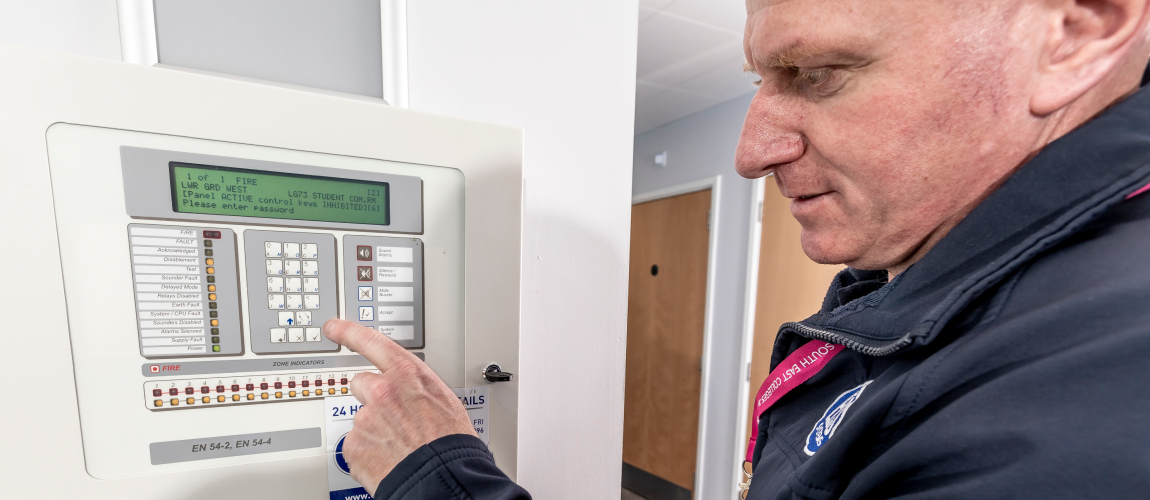
Although the phrase most people search for is weekly testing, good fire safety management normally starts with simple routine observation. Site teams or nominated staff should keep an eye on the control panel for faults, disablements, warning indicators, or anything unusual. They should also be alert to issues raised by staff, such as devices damaged by impact, detectors affected by dust, or repeated false alarms from particular areas.
These simple checks are valuable because they allow schools to spot obvious problems early, rather than waiting for the next formal test or engineer visit.
Department for Education estate guidance states that fire detection and alarm systems in schools should have a weekly alarm test. Where there are multiple manual call points, a different one should be tested each week so that, over time, all call points are included in the schedule. The same guidance says the system should also be subject to inspections and tests by a competent person, and that all fire alarm work, including routine testing, should be recorded and accessible to the fire service.
For most schools and colleges, the weekly test is therefore the core user check. It shows that the alarm can be activated from the field, the panel responds correctly, the signal can be heard, and staff remain familiar with the sound and process.
A weekly fire alarm test should be planned, brief, and controlled. It is not the same as a full evacuation exercise, and it should not create unnecessary disruption to teaching or examinations.
Best practice is to operate a different manual call point each week, rotating around the site until all relevant call points have been tested in sequence. This helps demonstrate that individual call points are functioning properly and that faults in a single location are less likely to be missed.
For larger schools and college campuses, that rotation becomes even more important. A site with multiple buildings, blocks, or teaching wings should have a clear schedule so that testing does not become informal or repetitive.
In most cases, the alarm should sound long enough to confirm that it has operated correctly, but not for so long that it causes avoidable disruption. Staff should know when the weekly test is due, and reception or security teams should be aware in case external monitoring arrangements need to be managed.
Advance notice matters. If the school has an alarm receiving centre, monitored connection, or out-of-hours security response, the relevant parties should be notified before the test to avoid unnecessary call-outs or confusion.
Relevant staff should know the normal weekly test time, especially in larger buildings or where there are hearing-impaired occupants, peripatetic staff, external hirers, or contractors on site. A predictable schedule helps reduce uncertainty while still allowing the school to confirm the alarm is audible and recognised.
Yes. Weekly user testing is essential, but it is not a substitute for planned servicing and maintenance by a competent fire alarm specialist.
Government guidance for educational premises refers to six-monthly testing and maintenance by a competent person. Department for Education estate guidance summarises the regime as quarterly and annual inspections and tests by a competent person. In practical terms, schools should follow the maintenance schedule appropriate to their system design, risk profile, and provider recommendations, while ensuring servicing aligns with recognised standards and the needs of the premises.
Professional servicing goes beyond operating a call point. It can include checking detectors, sounders, batteries, panel functions, fault monitoring, interfaces, standby power arrangements, device condition, and overall system performance. It is also the right time to identify developing issues, such as device contamination, damaged equipment, obsolete components, or areas where building changes may have affected coverage.
This matters in schools because sites are rarely static. Classrooms are repurposed, temporary accommodation appears, refurbishment works take place during holidays, and layout changes can alter the way the alarm system should perform.
The detail will depend on the maintenance plan, but the main point is that schools should not rely on the weekly bell test alone. A school may have routine user checks every week, periodic servicing visits by a competent engineer, and a broader annual review of performance, records, and building changes. What matters most is that the regime is documented, followed consistently, and appropriate for the building.
This is a common area of confusion. A fire alarm test is not the same as a fire drill.
A test checks that the system operates. A drill checks that people respond properly to the alarm and that evacuation procedures work in practice. Government guidance for schools emphasises the importance of familiarising staff and pupils with emergency evacuation procedures, and schools are expected to have regular fire drills as part of their wider fire safety management.
For many schools, a termly drill is a sensible operational benchmark, although the precise frequency should reflect the premises, age group, complexity of the site, and findings of the fire risk assessment. Colleges and more complex educational estates may also need to think carefully about staggered timetables, evening use, public events, and third-party occupation.
Fire alarm testing should always be recorded. This is not just an administrative detail. Records help demonstrate that checks have taken place, show whether faults are recurring, and provide evidence of responsible management if the school is ever questioned by enforcing authorities, insurers, governors, or auditors.
A logbook provides continuity. If testing is shared between site staff, caretakers, estates personnel, or external maintenance providers, the logbook becomes the central record of what was tested, when, and with what result.
A useful record will normally include the date and time of the test, the call point or area tested, the name of the person carrying it out, whether the alarm operated correctly, any fault or delay identified, and what remedial action was taken. Professional servicing visits, false alarms, disablements, and major changes to the system should also be recorded.
For multi-site academy trusts or college groups, consistency matters even more. A standardised approach to testing and record keeping makes it easier to manage compliance across a portfolio rather than site by site in isolation.
One of the most common problems is inconsistency. The weekly test is known in principle, but it gets missed during holidays, exams, inset days, or staffing changes. Another issue is relying on memory instead of a documented rota, which can result in the same call point being tested repeatedly while others are overlooked.
There is also a risk in treating every fire alarm issue as a nuisance rather than a signal that the system needs review. Repeated false alarms, recurring panel faults, damaged devices, and ignored disablements can all point to a maintenance or management problem that needs professional attention.
Holiday periods are another weak point. Summer works, contractor activity, temporary shutdowns, and room moves can all affect the fire alarm system. Schools and colleges should make sure testing, maintenance, and reoccupation checks are built into holiday project planning rather than dealt with retrospectively.
For most schools and colleges, the right answer is to combine weekly user testing with a structured maintenance programme, clear record keeping, and periodic review of whether the system still suits the building.
If a site has changed significantly, if the fire alarm logbook shows repeated faults, or if different buildings are being managed in different ways across the same estate, it may be time to review the current regime. This is where specialist support becomes valuable. A provider that can handle fire alarm servicing, remedial works, planned maintenance, and compliance support across multiple educational buildings can help reduce risk and bring more consistency to the process.
So, how often should fire alarms be tested in schools and colleges? In practice, the answer is weekly for routine user alarm testing, supported by regular visual checks, competent-person servicing, accurate record keeping, and periodic fire drills.
That layered approach matters because educational premises are busy, changeable environments where a single missed check can become a wider compliance or life safety issue. The most effective schools and colleges do not treat fire alarm testing as a one-off task. They treat it as part of a managed fire safety system that supports pupils, staff, visitors, and the wider estate over time.
Follow Us |

|

|

|
© ECS Systems 2026
ECS Systems Limited, 75 Station Rd, Sidcup DA15 7DN
|
|
|
|
© ECS Systems 2026