
Insights



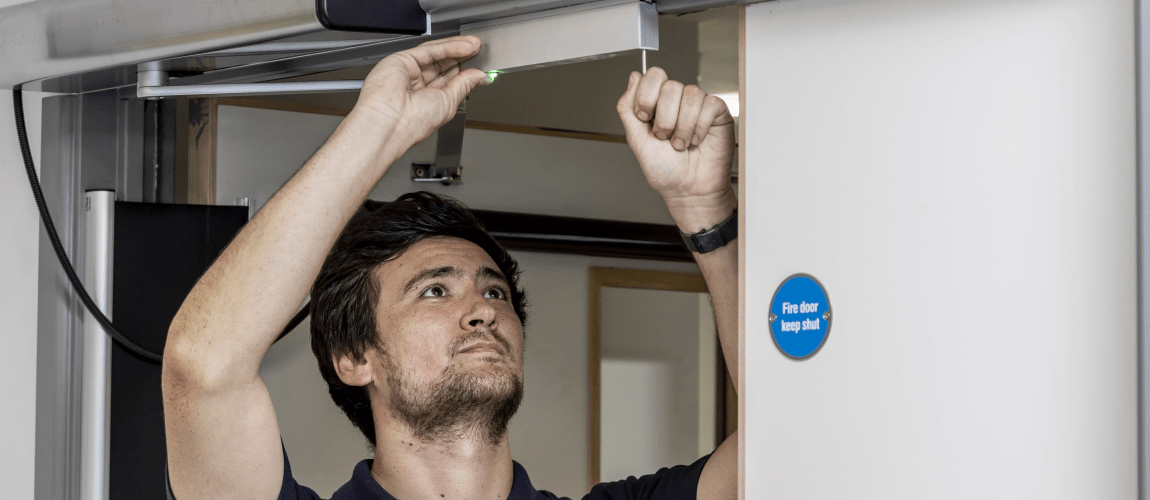
In schools, colleges, and wider educational estates, fire doors do far more than separate rooms. They protect escape routes, slow the spread of smoke and fire, support compartmentation, and help staff and pupils move to safety in an organised way if an incident occurs.
That is why inspection frequency matters. A fire door only performs properly when the complete doorset is in good condition and working as intended. If a closer has failed, seals are missing, glazing is damaged, or the door is routinely wedged open, the fact that it was originally specified as a fire door offers very little reassurance.
For facility managers, estates teams, bursars, and responsible persons, the practical question is usually not whether fire doors should be inspected. It is how often they should be checked, by whom, and at what level of detail.
The short answer is that educational buildings need a layered approach. Staff should remain alert to obvious defects during day-to-day use. Routine checks should form part of the school’s ongoing fire safety management. More formal inspections should be completed at planned intervals and after significant changes.
Educational buildings place heavy day-to-day demands on doors. Hundreds of people may use the same circulation routes each day. Doors are opened repeatedly between lessons, propped open for convenience, knocked by trolleys, and affected by constant wear around hinges, frames, closers, and seals.
Schools also combine a wide mix of occupancies and building types. A single campus may include classrooms, assembly spaces, kitchens, plant rooms, offices, sports facilities, libraries, labs, and temporary or historic buildings. That increases the need for reliable compartmentation.
When a fire door is not closing properly or its components are defective, the issue is not cosmetic. The door may fail to hold back smoke and flame long enough to protect corridors, protected stairs, or key escape routes. In a school environment, where evacuation has to work quickly and clearly for staff, pupils, contractors, and visitors, that can have serious consequences.
There is no single standalone law that says every fire door in every educational building must be inspected on one universal timetable. The position is more practical than that.
Current government guidance for schools says that all fire doors must remain in efficient working order and should be regularly checked and maintained by a competent person. It also sets out what an inspection should look at, including self-closing devices, hold-open devices, glazing, signage, damage, distortion, seals, ironmongery, and whether doors are being propped open.
The educational premises fire risk assessment guide adds an important point: the appropriate period for checks should be determined from the fire risk assessment, and the example testing and maintenance intervals are not intended to be prescriptive. That matters because a small modern primary school and a large college campus do not present exactly the same inspection needs.
Even so, the same guide gives schools a practical framework. It points to daily checks of escape routes and doors on those routes, monthly checks that fire doors are in good working order and closing correctly, and annual inspection of structural fire protection and elements of compartmentation. So while there may not be one fixed interval for every door, there is a clear expectation of regular, documented checking.
For most educational buildings, the most sensible answer is to think in layers rather than rely on a single inspection date in the diary.
The educational premises guide recommends daily checks of escape routes, including ensuring that doors on escape routes swing freely and close fully. In a school setting, this is often the first line of defence because issues are frequently obvious in normal use.
Caretakers, site teams, premises staff, and other nominated staff should be alert to problems such as doors that no longer latch, closers that slam or fail to close, damaged edges, broken vision panels, or corridors where doors are routinely wedged open. Final exit doors and routes should also remain unobstructed and usable.
These are not full technical inspections, but they matter. In many cases, the earliest warning sign of a problem is simply that a door no longer behaves properly in daily use.
This is the clearest formal interval in the school-specific guidance. The educational premises fire safety guide says that, on a monthly basis, schools should check that all fire doors are in good working order, are closing correctly, and that the frames and seals are intact.
For many schools, that monthly check is the minimum practical benchmark for internal inspection. It should be recorded, assigned to a nominated person, and applied consistently across the site.
Monthly checks should typically look at whether:
– the door closes fully into the frame
– the self-closing device works correctly
– intumescent and smoke seals are present and undamaged
– hinges, latches, and ironmongery are secure
– glazing and beads are intact
– the frame is not damaged or distorted
– the door is not being altered, obstructed, or held open improperly
Government guidance for schools also says that all structural fire protection and elements of fire compartmentation should be inspected annually, with any remedial action carried out. That is a strong sign that schools should not rely solely on informal visual checks.
A competent-person inspection or survey becomes especially important in older buildings, sites with many doors, buildings with mixed ages of construction, and estates where there have been refurbishments, extensions, or changes in room use.
In practice, many educational organisations go further than the minimum implied annual review and adopt a more structured programme, particularly on higher-risk or harder-worked doors. The right interval should be based on use, condition, complexity, and the findings of the fire risk assessment.
Not every door faces the same level of risk or wear.
Doors protecting escape corridors and stair enclosures are usually among the most critical because they help keep evacuation routes usable. If these doors fail, smoke spread can affect the very routes occupants depend on to get out safely.
Doors serving plant rooms, electrical cupboards, risers, kitchens, workshops, and other higher-risk spaces also deserve close attention. In educational estates, high-traffic doors can also degrade faster simply because of daily use.
One of the most common problems is poor self-closing performance. A closer may have failed, been adjusted badly, or been disconnected. The result is a door that does not close fully or latch reliably.
Missing or damaged seals are also common. Intumescent and smoke seals are part of the fire door assembly. If they are painted over, missing, torn, or loose, performance can be compromised.
Schools also frequently encounter impact damage, glazing issues, unauthorised alterations, unsuitable ironmongery, and doors that have been wedged open by staff for convenience. The Department for Education has highlighted non-compliant internal fire doors, ineffective closing mechanisms, and locked or obstructed exits among the common issues seen during school fire risk assessments.
At a minimum, schools should keep a clear fire logbook or compliance record showing what was checked, when, by whom, what defects were identified, and what action was taken. A defect that is recorded but never followed through remains a safety risk.
For larger sites, it helps to maintain a register of fire doors by building, floor, and location. That makes it easier to track repeat faults, prioritise remedial works, and budget sensibly.
This becomes even more important for multi-academy trusts, independent school groups, and colleges with several buildings. Central oversight can make it easier to compare standards across sites, identify recurring issues, and ensure remedial work is not drifting.
A full survey is especially sensible when there is uncertainty about the condition, suitability, or consistency of doors across the estate.
That might be because the site has not had a detailed fire door inspection for some time, the building is older or has been altered repeatedly, the fire risk assessment has raised concerns, or leadership needs a clearer basis for budget and remediation decisions.
A survey should not be seen as separate from action. The real value lies in what happens next: prioritising risk, planning repairs or replacements, coordinating works around term time, and making sure any remediation is appropriate to the certified door assembly and the building’s wider fire strategy.
For many educational buildings, this is where specialist support becomes valuable. ECS’s fire door service offering is built around surveys, remediation planning, and ongoing compliance support for schools and larger estates, which is particularly useful when sites need more than a simple one-off check.
So, how often should fire doors be inspected in educational buildings?
The most accurate answer is that schools need more than one interval. Staff should stay alert to obvious defects in daily use. Government guidance for educational premises points to monthly checks that doors are in good working order and closing correctly, while broader annual inspection of structural fire protection and compartmentation is also expected. The exact programme should then be refined through the fire risk assessment and the realities of the building.
For facility managers and responsible persons, the goal is not simply to pick a frequency and hope for the best. It is to create a documented inspection regime that matches the site, prioritises critical doors, and leads to timely remedial action.
In educational environments, fire door compliance is strongest when inspection, record-keeping, and remediation all work together. That is what turns a checklist into real protection.
Follow Us |

|

|

|
© ECS Systems 2026
ECS Systems Limited, 75 Station Rd, Sidcup DA15 7DN
|
|
|
|
© ECS Systems 2026